Tracing the Path to Literacy: The Distinctive Role of Kids Arabic Font in Education and Design
In the realm of typography, the relationship between a letterform and its reader is usually passive; the eye scans, and the brain interprets. However, in early childhood education, this relationship must become tactile, interactive, and forgiving. This is precisely where Kids Arabic enters the conversation. Far more than just a set of characters, Kids Arabic is a specialized, dashed display font designed to bridge the gap between recognizing a letter and physically forming it. While its primary function is to serve as a guide for letter tracing worksheets, its unique aesthetic offers a surprising versatility for various creative projects.
The Anatomy of a Learning Tool
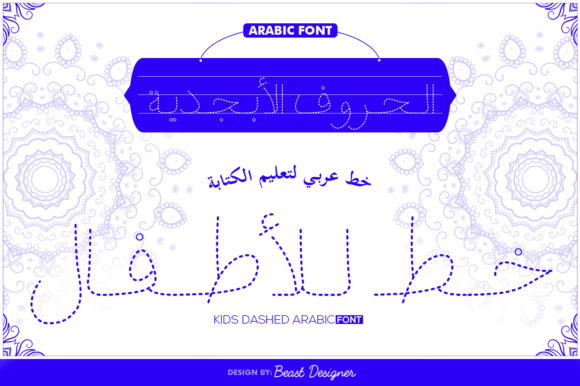
At its core, Kids Arabic addresses a specific pedagogical challenge: teaching the flow and structure of Arabic script to beginners. Unlike standard fonts that present solid, opaque strokes, this typeface utilizes a "dashed" or dotted style. This design choice is intentional and functional. By presenting the letter as a series of disconnected segments, the font invites the user to mentally and physically connect the dots. This process is crucial for developing fine motor skills and muscle memory.
The characteristics of Kids Arabic are defined by clarity and approachability. The letterforms are typically crafted with a consistent stroke width, avoiding the complex calligraphic variations that can confuse a novice learner. The spacing is generous, providing ample room for a child’s hand to maneuver a pencil or crayon without feeling constrained. It is this balance of structure and openness that makes the font an effective educational scaffold.
Real-World Applications: From Classroom to Studio
While the obvious application for Kids Arabic is within the classroom—specifically for creating handwriting practice sheets—its utility extends into broader creative territories. Understanding the versatility of this font can unlock new possibilities for designers and content creators.
Educational Materials and Homeschooling
For teachers, parents, and homeschooling educators, Kids Arabic is an invaluable asset. The font allows for the rapid generation of customized worksheets. Instead of relying on pre-printed, generic workbooks, educators can type out specific words, sentences, or letters tailored to a student's current learning stage. Whether it is mastering the isolated form of a letter or practicing how it connects to others, the font provides a consistent template that can be printed on demand.
Design and Decor
Beyond the classroom, Kids Arabic finds a home in the world of design. Its dashed aesthetic gives it a hand-crafted, "work-in-progress" look that is highly sought after in modern design trends. Consider the following scenarios:
- Wall Art: A large-scale print of a child’s name using Kids Arabic can serve as a charming piece of nursery decor that doubles as an educational tool.
- Scrapbooking: The font adds a playful, educational texture to digital or physical scrapbooks, particularly for pages documenting a child’s first steps in writing.
- Greeting Cards: For cards aimed at young learners or celebrating milestones like starting school, this font conveys a sense of growth and potential.
Digital Interfaces and Apps
With the rise of educational technology, app developers can integrate Kids Arabic into interactive learning platforms. The dashed lines are perfect for digital tracing exercises where a child uses a finger or stylus to trace the path on a tablet screen. The font’s clear structure ensures that the software can accurately detect when the user has successfully connected the segments.
Evaluating the Aesthetic Value
When evaluating Kids Arabic for a project, it is important to look beyond its educational function and appreciate its visual weight. As a display font, it possesses a unique personality. It is friendly, informal, and energetic. This makes it an excellent choice for projects that aim to evoke feelings of innocence, creativity, or learning.
However, like any specialized typeface, it requires context. Because Kids Arabic is designed for tracing, it is not intended for long-form body text or official documentation. Its legibility relies on the "gaps" in the letters, which can become distracting if used in dense paragraphs. Therefore, it is best employed for headlines, logos, or standalone artistic elements where its unique dashed construction can be fully appreciated.
Practical Considerations for Implementation
For professionals looking to add Kids Arabic to their toolkit, there are a few practical considerations to keep in mind to ensure the best results.
- Scaling and Sizing: Because the letters are composed of dashes, scaling the font too small may cause the dashes to merge into a solid line, defeating the purpose. It is recommended to use Kids Arabic at larger sizes to maintain the integrity of the tracing path.
- Color and Contrast: While the font works well in standard black, it can be enhanced by using colors. For a tracing worksheet, printing the font in a light grey and asking the child to trace over it in dark pencil is a classic technique. For design purposes, using vibrant colors can highlight the segmented nature of the typeface.
- Pairing with Other Fonts: To create a balanced design, pair Kids Arabic with a clean, simple sans-serif font for any accompanying instructions or body text. This creates a contrast that guides the viewer's eye, ensuring the educational or artistic element stands out without overwhelming the layout.
The Value of Specialized Typography
The existence of fonts like Kids Arabic highlights a broader truth about the world of typography: one size rarely fits all. General-purpose fonts are workhorses, but specialized fonts are the surgical tools of design. They solve specific problems—in this case, the cognitive and motor challenges of learning a new script.
For business owners in the education sector, investing in or utilizing Kids Arabic can elevate the quality of their products. A well-designed tracing sheet feels more professional and thoughtful than a hastily photocopied page. It shows an understanding of the user's needs and a commitment to providing a supportive learning environment.
Conclusion: A Favorite in the Making
Whether you are a teacher crafting a curriculum, a parent guiding a child’s first steps in literacy, or a designer looking for a unique typographic texture, Kids Arabic offers a compelling solution. It transforms the abstract concept of a letter into a tangible, traceable journey. Its design is not merely aesthetic; it is functional, supportive, and inherently creative.
Adding Kids Arabic to your portfolio is more than just acquiring a new font; it is adopting a tool that facilitates learning and creativity. Its dashed lines are not just empty spaces—they are invitations to participate, to trace, and to learn. In a digital world that often feels static, this font brings a dynamic, interactive quality that can enrich any project it touches.